
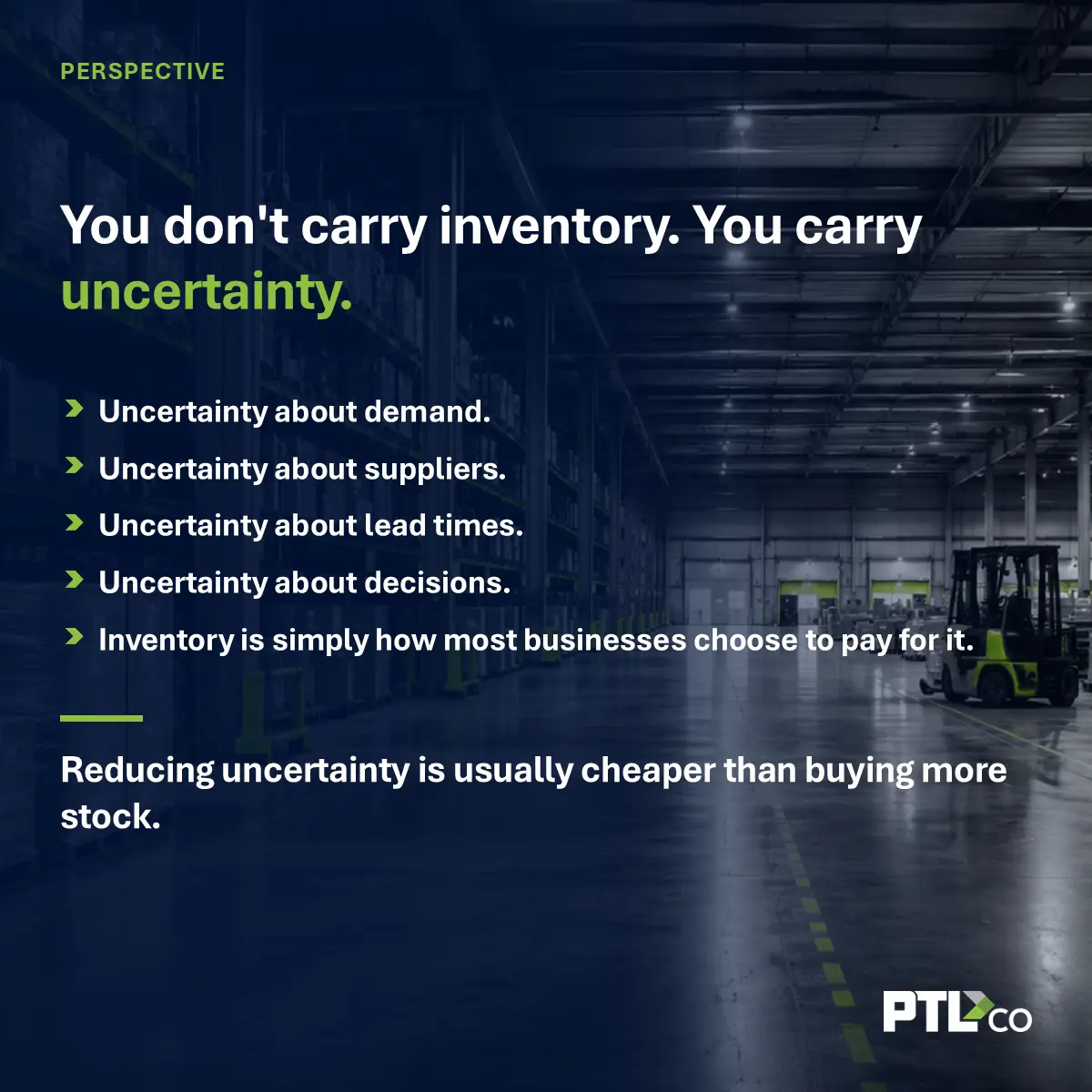
Inventory is usually treated as a physical problem. Too much stock means purchasing bought too much, the forecast was wrong, or inventory parameters need adjusting. Sometimes that is true. But often, excess inventory is simply the visible consequence of uncertainty elsewhere in the business.
Uncertainty about demand. Uncertainty about suppliers. Uncertainty about lead times. Uncertainty about production capacity. Uncertainty about which products customers will actually buy. And sometimes uncertainty about the decisions the business is prepared to make.
Inventory is how many businesses protect themselves against all of this.
When confidence is low, the natural response is to add stock. Increase the safety stock. Order earlier. Buy a little more. Hold an extra week’s cover. Individually, each decision can appear perfectly rational. Collectively, they can create a significant amount of inventory.
This is why inventory optimisation isn’t simply a matter of lowering stock parameters. If the uncertainty remains, reducing the inventory that protects against it can simply move the problem elsewhere, creating shortages, expediting costs and service failures.
The better question is not “How much inventory can we remove?”
It is “Why do we need this inventory in the first place?”
Better forecasting may reduce one source of uncertainty. More reliable suppliers may reduce another. Shorter lead times, clearer planning rules, better data and faster decision-making can reduce others.
The objective should not therefore be the lowest possible inventory.
It should be the right inventory for the uncertainty the business genuinely needs to carry.
Because inventory has a cost. But so does uncertainty. And inventory is simply how most businesses choose to pay for it.