
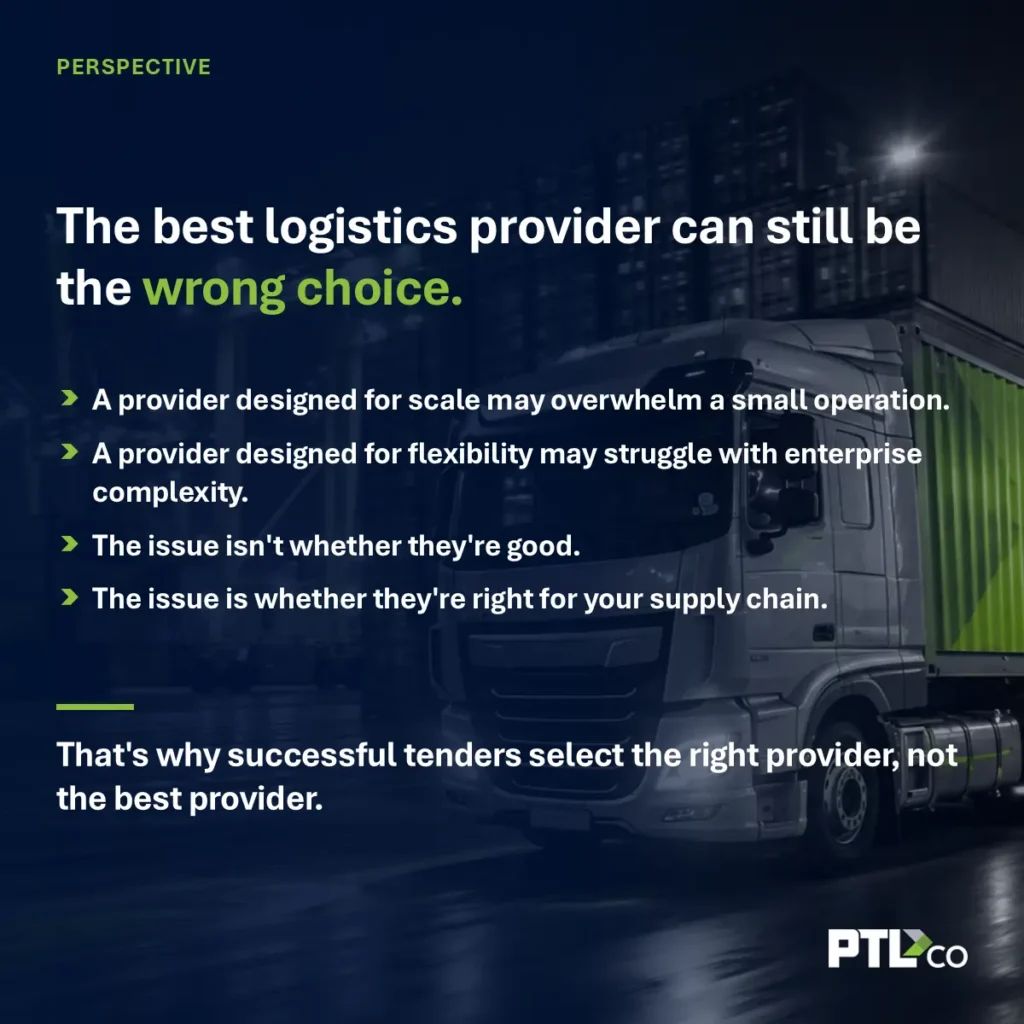
The strongest logistics provider in the market is not automatically the strongest provider for your business. Capability matters, but so does fit.
Large providers can offer extensive networks, technology, capacity and sophisticated operational infrastructure. For businesses with significant scale and complexity, those capabilities can be exactly what is required. But the same operating model can introduce processes, minimum requirements or levels of complexity that simply do not suit a smaller operation.
The reverse is equally true. A smaller, more flexible provider may offer excellent service, responsiveness and commercial agility, but struggle when volumes increase, operating requirements become more complex or the supply chain expands internationally.
That is why effective logistics tendering and provider selection should not simply identify which bidder appears strongest overall. It should establish which provider is best aligned with the specific characteristics and requirements of the operation.
Volume, shipment profile, geography, service requirements, technology, growth expectations, operational complexity and the importance of the account to the provider can all influence whether the relationship will work in practice.
The distinction matters because a provider can perform exceptionally well for one customer and be completely unsuitable for another. That does not make the provider good or bad. It means logistics partnerships are contextual.
Successful tendering therefore focuses on alignment rather than reputation. The objective is not to identify the biggest network, the longest capability list or the most impressive presentation.
It is to identify the provider whose operating model fits your supply chain.