
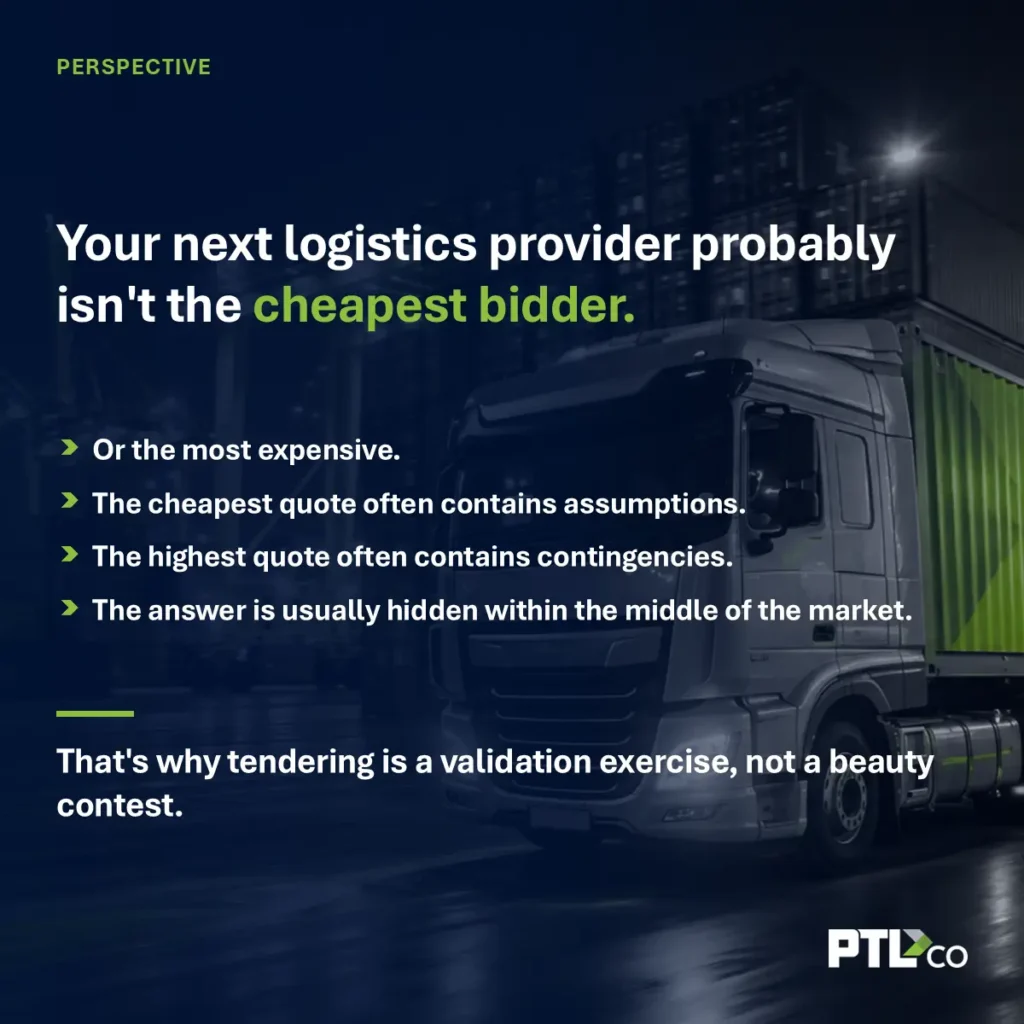
he cheapest logistics tender response can be difficult to ignore. When rates are laid out side by side, the lowest number creates an obvious benchmark against which every other bidder is judged. But price alone rarely tells you which provider represents the best commercial decision.
A low quote may depend on assumptions about volumes, shipment profiles, service requirements or operating conditions that will not survive implementation. Once those assumptions are tested, the apparent saving can quickly disappear. Equally, the most expensive bidder is not necessarily offering the best service. Higher pricing can reflect additional contingencies, conservative assumptions or simply a different appetite for the business.
That is why effective logistics tendering and procurement should be less about identifying the lowest headline rate and more about understanding what sits behind each proposal. The objective is to create genuine comparability between bidders, challenge assumptions and establish whether the proposed solution can actually deliver the required service at the stated cost.
The strongest option is often somewhere between the extremes. It may not win every individual rate comparison, but it provides the right balance of cost, capability, service, resilience and commercial clarity.
A tender should therefore be treated as a validation exercise, not a beauty contest. The spreadsheet may identify the leading candidates, but robust evaluation determines which proposal will work in practice.
The best logistics provider is not necessarily the cheapest or the most expensive. It is the one whose offer still makes sense once the assumptions have been removed.